


The influence of mass media on the political subjectivity of society and citizens
https://doi.org/10.21453/2311-3065-2026-14-2-141-154
Abstract
The subjectivity of modern mass media in the formation and regulation of political activity and political participation of society is considered. The relevance of the problem of media subjectivity in modern politics is substantiated in connection with the rapid development of artificial intelligence and electronic media, displacing the influence of traditional media on the mass consciousness of citizens, their political activity and political participation. The expansion of the role of the scientific media segment in the manifestation of the subjectivity of science and scientists in determining the priorities of public policy in responding to modern challenges, dangers and threats to the vital interests of individual citizens and society is substantiated. The role of mass media as a factor of increasing the influence of scientists, journalists, and elite groups on politics is shown. The article examines the dynamics of the functions of the Russian mass media in various historical periods – Soviet and post-Soviet. These functions are considered in the context of the dynamics of political activity and political participation of citizens and groups. An attempt is made to reveal the mechanisms of the mediated influence of the media on political governance and public policy in various fields (using the example of the state policy of ensuring environmental, information and public safety). The author’s analysis of sociological research by Yu. A. Zubok, O.V. Sorokina, T. N. Samsonov (2010-2018) allows him to conclude that there is a lack of a unified understanding in the mass consciousness of the essence of political subjectivity, the dynamic nature of citizens’ political activity, and their political participation in socio-political transformations. The dynamism of political subjectivity on a national scale consists in constitutionalization through political modernization of the political system and discourses. Today, the main distinguishing markers of the political subjectivity of society are the political activity of citizens, their political responsibility and political culture, expressed in political competence. Mass media are a means of developing distinctive markers of the political subjectivity of individual citizens and their groups.
About the Author
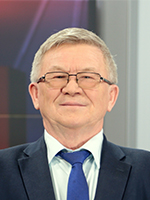
A. P. Sitnikov
Russian Presidential Academy of National Economy and Public Administration
Russian Federation
Russian Federation
Sitnikov A.P., doctor of political sciences, professor
84 Vernadsky Ave., Moscow, 119606.
References
1. Vasiliev I.V., Sitnikov A.P. (2025). Mass media as an instrument of state policy to preserve the historical memory of Russians // Ideas and ideals. Vol. 17. No. 3. Part 2, pp. 437-48. D01: 10.17212/2075-0862-2025-17.3.
2. Vasiliev I.V. (2023). Development of the theoretical and methodological foundations of the state policy of the Russian Federation in the field of preparing the country’s population for defense. Moscow: VAGSH. 360 p. (in Rus.).
3. Vozzhenikov A.V. (1970). The struggle of the workers of the Urals for the implementation of Lenin’s plan for building socialism. Perm: Perm State University of Economics. 54 p. (in Rus.).
4. Vozzhenikov A.V. and others (2008). Global challenges, dangers and threats of our time. Priorities of national security policy: A monograph. Moscow: RAGS. 240 p. (in Rus.).
5. Grachev G., Molnik I. (2003). Personality manipulation: organization, methods and technologies. Moscow: Eksmo. 246 p. (in Rus.).
6. The Law of the Russian Federation «On Mass Media» dated December 27, 1991 No. 2124-1 (as amended on June 3, 2025) [Electronic resource] base/garant.ru (accessed 03/20/2026). (in Rus.).
7. Zinenko V.E. (2019). Features of the formation of political subjectivity of modern Russian youth // Bulletin of the Moscow University. Episode 12. Political sciences. No. 6, pp. 98-108. (in Rus.).
8. Zinenko V.E. (2022). The formation of patriotism based on the heroes of our time. In: Youth in the New Reality: Proceedings of the First All-Russian Interdisciplinary Scientific Conference. Moscow. 29-30 S and Publishing. 249 p. (in Rus.).
9. Zubok Yu.A. (2020). Social activity of youth: ideological foundations of self-regulation // Power and management in the East of Russia. No. 2 (91), pp. 89-105. (in Rus.).
10. Easton D. (1997). Categories of systemic policy analysis. // Anthology of world political thought / edited by T.A. Alekseeva. Moscow: Mysl. Vol. II, pp. 630-642. (in Rus.).
11. Easton D. (2015). An approach to the analysis of political systems // Bulletin of the Moscow University. Episode 12. Political Science. No. 5, pp. 17-37. (in Rus.).
12. Kuznetsov A.N. (2023). The topic of patriotism and citizenship in the Russian media. Moscow: RANHiGS. 176 p. (in Rus.).
13. Lassuel G. (2021) Propaganda techniques in the World War. Moscow: INION RAS. 248 p. (in Rus.).
14. Lisova S.Y. (2011). Political functions of mass media // Bulletin of IGEU. Issue 2. (in Rus.).
15. Malik E.N. (2021). The digital media environment as a resource for youth political participation // Bulletin of the Prikamsky Social Institute. No. 1 (88), pp. 179-183. (in Rus.).
16. Maslanov E.V. (2024). Science and technogenic civilization: on the issue of the humanistic project of science: monograph. Moscow: Russian Society of History and Philosophy of Science. 196 p. (in Rus.).
17. Nigulin E., R., Shubin A.E. (2019). The specifics of the transition of Internet media into the space of real political protest (on the example of protest actions in Russia in 2017-2018) // Skif. № 5-1 (33). URL: http: //cyberleninka.ru/article/n/spetsilika (Date of request – 03/23/2026). (in Rus.).
18. Peterson, T., Siebert, F., and Schramm, W. (1998).Four theories of the press. Translated from English. Vagrius Publishing House. 232 p. [Electronic resource] www.livelib.ru (Date of request – 21.03.2026). (in Rus.).
19. Privalov E.V. (2020). The influence of Russian online media on the political activity of young people. [electronic resource]. pure.spbu.ru (Date of request – 03/23/2026). (in Rus.).
20. Political subjectivity of regional societies and elites: dynamics, problems and scientific and practical conferences. 2014. Saratov. (in Rus.).
21. Porus V.N., Bazhenov V.A. (2021). Prospects of politicization of scientific knowledge in the aspect of postnormal science // Philosophy. Journal of the Higher School of Economics. Vol. 5. No. 4, pp. 78-82. (in Rus.).
22. Porus V.N., Bazhanov V.A. (2021). The Political Subjectivity of modern Science: an Interdisciplinary Analysis at the Crossroads of Philosophy of Science and Philosophy of Politics // Philosophy. Journal of the Higher School of Economics. Vol. 5. No. 4, pp. 78-82. (in Rus.).
23. Pugacheva Z.A. (2020). Prospects for the development of mediation in modern Russia. [Electronic resource] www. pune.spbu.ru (Date of request – 23.03.2026). (in Rus.).
24. Vladimir Putin (2026). Speech at the Congress of Industrialists and entrepreneurs. Moscow. March 26, 2026. (in Rus.).
25. Samsonova T.N. (2018). On the formation of the political subjectivity of Russian youth in the process of political socialization // Society: sociology, psychology, pedagogy. No. 7, pp. 28-34. (in Rus.).
26. Topchy I.V. (2018). Media text message: the connection of visual and emotional // Sign: a problematic field of media education. No. 3 (29). (in Rus.).
27. Tretyakova E.A., Antropova V.V. (2019). The phenomenon of news texts in the socio-cultural paradigm // Medisred. No. 1. URL: http//Cyberleninka.ru/article/n / (date of request – 23.03.2026). (in Rus.).
28. Sharkov F.I., Andrianova T.V. (2025). Media inclusion: genesis, paradigms and themes // Kommunikologiya, vol. 13, No. 4, pp. 13-21. (in Rus.).
Review
For citations:
Sitnikov A.P. The influence of mass media on the political subjectivity of society and citizens. Communicology. 2026;14(2):141-154. (In Russ.) https://doi.org/10.21453/2311-3065-2026-14-2-141-154
Views:
10
JATS XML



 Email this article
